
People
Notable People
Richard J. Fleischman - Master Architect
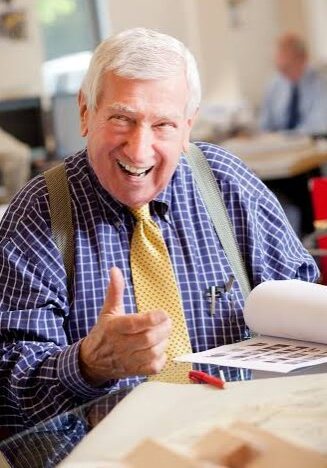
Cleveland native and renowned architect Richard J. Fleischman left a lasting mark on Bratenahl, where he designed the striking glass houses surrounding the Breezy Bluff mansion on Cushing and Spring Bank Lanes. His influence extended across the Cleveland area and to the many people who knew him.
Richard Joseph Fleischman was born in Cleveland on November 27, 1928, to Joseph F. and Lillian P. (Perz) Fleischman. An uncle who noticed his talent for drawing and model building urged him to study architecture. In his senior year at East Tech High School, he earned a scholarship to Carnegie Tech, now part of Carnegie Mellon University. After five years there, he spent two years at Columbia University and a year on a travelling fellowship visiting historic sites in Italy, Spain, Greece and Scandinavia. His master’s thesis, which defined space in European architecture, shaped his view of architecture as “sculpted space.”
Richard married Marlene Amelia DeMore on August 30, 1952. They had three daughters, Gayle, Kimberly and Ann, and although the couple later divorced, the family stayed close and supportive.
Fleischman worked for Cleveland architect William H. Conrad in the late 1950s and early 1960s, then opened his own firm in 1961. In nearly six decades, Richard Fleischman and Associates + Partners completed about 500 projects in Northeast Ohio and beyond and won hundreds of design awards, including the 1988 AIA Ohio Gold Medal Firm Award. Fleischman became a member of the AIA College of Fellows in 1974 and received the AIA’s individual Gold Medal in 2001. The firm was known for modernist, light-filled “shared spaces” with clean geometric lines, expansive glass and sculpted open volumes. Rather than adding surface ornament, it stressed structural proportion, openness and a link between indoors and outdoors.
Often called a “Master Church Designer,” Fleischman designed about 70 churches and synagogues. The best known is St. Paschal Baylon Church in Highland Heights, Ohio, a soaring mirror-glass building whose fan-shaped sanctuary draws the congregation closer to the altar. His firm pioneered open-plan school design in the 1970s, as at Villa Angela Academy in Cleveland, and later transformed brutalist campus buildings with glass-wrapped renovations of Morgens Hall and Scioto Hall at the University of Cincinnati. Other Ohio landmarks include the Goodyear Polymer Center (Polymer Science Building) at the University of Akron, the Ohio Aerospace Institute in Brook Park, and the Akron-Summit County Public Library. The Ohio Aerospace Institute, a glass-skinned research facility near Cleveland Hopkins Airport, evokes the spirit of flight. It earned a 1994 MDO Award as one of the world’s top 50 buildings, and New York architect Peter Pran called it “a masterpiece . . . full of movement and life, superb detailing and poetic and exuberant spaces throughout.”
Although known as an innovator rather than a preservationist, Fleischman gave old buildings new purpose. He converted a run-down downtown camera store into his elegant glass-fronted studio, and transformed a second-story space in a former Sears department store into the Cleveland Center for Contemporary Art (now the Museum of Contemporary Art Cleveland).
One of his most significant 21st-century works is the Cleveland Job Corps Center, a campus of nine pristine glass-and-tile buildings on a 25-acre site once occupied by a sprawling manufacturing complex.
Beyond large institutions, the studio designed striking private homes, such as the Breezy Bluff residences on Lake Erie in Bratenahl; helped shape the initial master plan for Cleveland’s Gateway Complex; and created public art, including the sculpture The Dancers at Case Western Reserve University.
He served on the boards of the Cleveland State University Foundation, Ohio Ballet and Carnegie Mellon Distinguished Alumni, spent 20 years on the Cleveland Fine Arts Committee, and graduated from Leadership Cleveland. He also took part in many organizations, including the Union Club, Cleveland Museum of Art, Cleveland Orchestra, Cleveland Arts Association, English-Speaking Union, Print Club of Cleveland, and St. Elizabeth’s Hungarian Church. In 2019 he was inducted into the Cleveland International Hall of Fame, a tribute to his Hungarian roots.
On September 5, 1987, Fleischman married Helen F. Moss, a stockbroker, philanthropist and community leader. Together they bought Breezy Bluff at 9619 Lake Shore Boulevard and the adjoining “Springbank” property at 9717 Lake Shore Boulevard. They renovated the Breezy Bluff mansion and lived there while developing eight custom townhomes, designed by Fleischman’s firm, on the 6.5 acres around it.
Breezy Bluff’s architectural identity rests on the deliberate contrast between a monumental 1905 Beaux-Arts/Classical Revival mansion and the ultra-modern, transparent glass-and-steel residences that surround it. These homes have clean geometric lines, exposed structural steel, concrete, porcelain, and floor-to-ceiling commercial glass walls that maximize natural light and Lake Erie views. Multi-level townhomes such as 9613 Cushing Lane rise to four stories, linked by curving staircases and private elevators and topped with entertaining spaces and large rooftop decks.
One standout is the Blackstone House on Spring Bank Lane, built on two combined parcels for Dr. Eugene and Janet Blackstone. This 9,000-square-foot residence is conceived as a modern glass-and-steel basilica, 34 feet wide by 96 feet long, crowned by a nearly full-length skylight and slightly rotated on its lot so it does not block neighbors’ lake views. Built to house a 7,406-pipe Aeolian-Skinner concert organ arranged across north and south apses, the interior features undulating walls, floor “F-holes,” and specialized acoustic paint calibrated to produce 2.75 seconds of smooth reverberation.
The project began with an intense two-day design meeting among Fleischman and two creative organ designers, John Nolte and Shawn Keith. The result is more than an aurally stunning masterpiece: it is a work of art born of close collaboration between the Blackstones and Fleischman.
Helen Moss, who spent years in philanthropy, collaboration and fundraising to fight cancer, died of the disease on November 9, 2013. Richard Fleischman died on June 20, 2020. They are buried at Lake View Cemetery.