
Places
Historical Places
Bratenahl Community Center
10500 Brighton Road
The BCF Creates the BCC
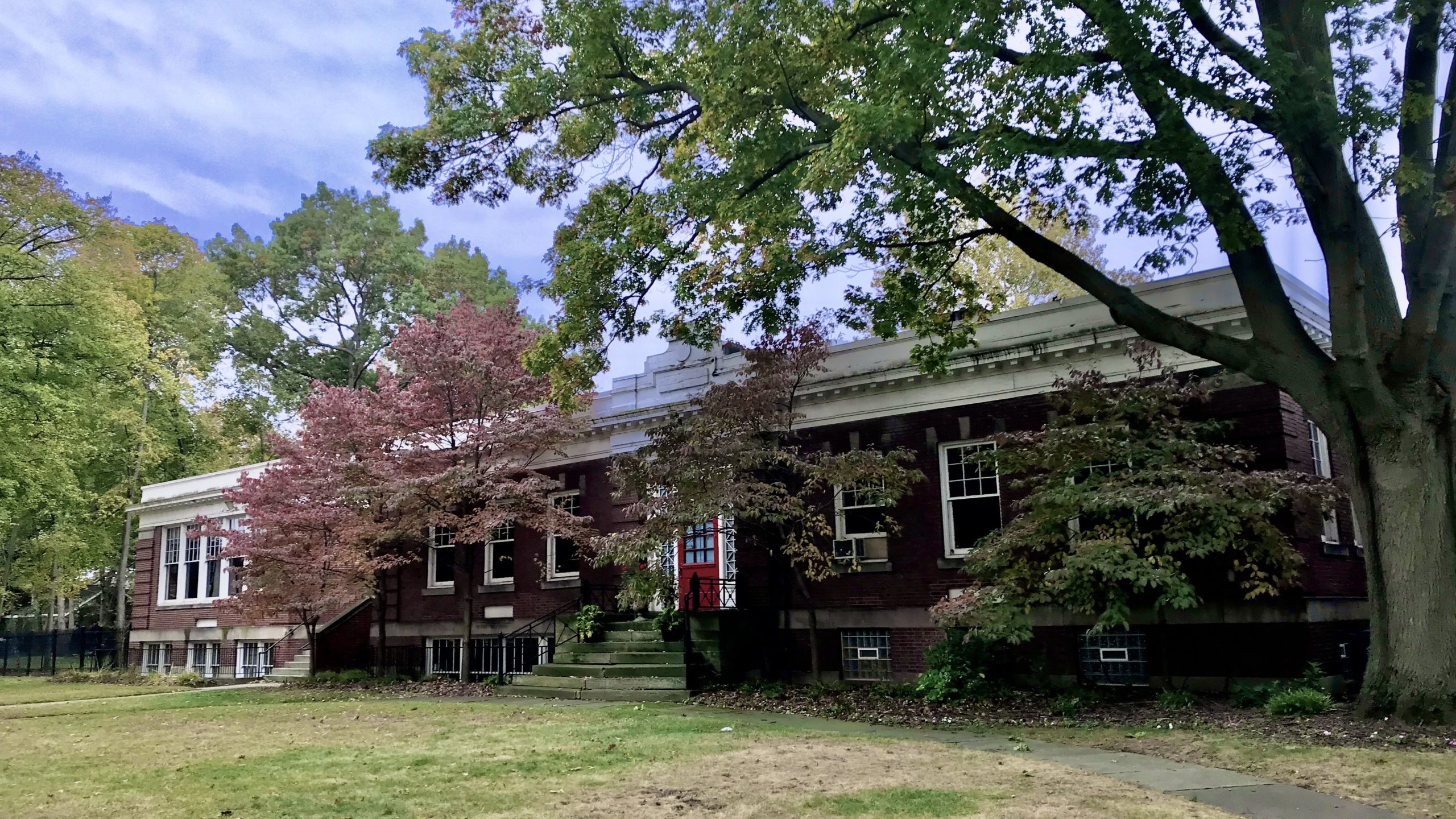
The Bratenahl School on Brighton Road was built in three segments. The original school building consisting of the central portion of the north wing of the current building opened in February 1907. The building was extended west in late 1914, adding additional classrooms and an office. An east wing, consisting of additional classrooms and a gymnasium was dedicated in September 1939. All three building segments were designed by noted architect Abram Garfield.
Following years of contentious litigation, the Bratenahl Village School District merged with the Cleveland Municipal School District (CMSD) in September 1979. At that time, title to the school building transferred to the CMSD. The school building was closed and the students disbursed to other Cleveland schools in the summer of 1981. Though occasionally rented by Village community groups for meetings or programs, the building remained empty for several years.
Beginning in 1986, the Bratenahl Community Foundation (BCF) lobbied for the return of the building for the purpose of operating a community center. A community needs survey conducted by the BCF at that time found that residents wanted the Village to provide child-care and after-school activities, a library, senior citizen programs, and adult continuing education, arts and exercise classes.
Initially, the BCF explored with Village leaders acquiring the building for a combined municipal building and community center. In February 1988, the Village hired the architectural firm of Rauschenbach, Casini and Urban to conduct a preliminary study to analyze the cost of rehabilitating the Bratenahl School Building and converting the school building into a Community Center, Police Station and Civic Administration Facility. The preliminary analysis estimated the total construction cost at approximately $1.3 million. Village leaders concluded that moving municipal functions into the school building was too costly.
The BCF proposed, in the alternative, that the Village lease the school building to the foundation for community education programs. In October 1988, the BCF presented to the Council a proposed business plan for the operation of a community center in the building at a cost of $28,000 for the first year of operation paid by the BCF. Accepting this plan, Village leaders joined with the BCF in urging the CMSD to return the school building to Bratenahl.
In January 1989, the CMSD agreed to sell the school building to Bratenahl for $1.00, even though the building was appraised at $216,000. The deed contained a condition that prohibited transfer of the property title to private developers for a period of twenty years. The Village, in turn, leased the building to the BCF. In the lease, the Village agreed to pay for building insurance and ground maintenance, while the BCF agreed to be responsible for operating, maintaining and renovating the facility for community use. The BCF obtained an $8,000 Ohio Department of Education implementation grant to fund community education and recreation programs.
The BCF selected Clara Childs Mackenzie as director to run the new Bratenahl Community Center (BCC) and more than 50 volunteers and Village Service Department workers painted, landscaped, cleaned and repaired the building. In its first year, the BCC hosted adult exercise activities, a children’s hour, an art group, senior group activities, piano lessons, a bridge group, a dog obedience program, and Project Learn. In addition, the Village Recreation Commission hosted a highly successful summer program involving 50 children and organized an after-school play group. The community center was used by 24 organizations and attracted hundreds of visitors. The BCF raised $25,000 in capital funds to renovate the building. The north wing was reroofed and the center hallway plastered and painted. The BCF hired a paid part-time custodian to maintain the building. The Village renewed the lease to the BCF for a second year.
In December 1990, the BCF announced a capital improvement campaign for the BCC to complete needed capital repairs to the building. In all, the BCF raised about $50,000 and obtained numerous in-kind gifts of furniture, equipment and appliances. In March 1991, the foundation hired the architectural firm of Zannoni, Heckaman, and Payto to prepare a full development plan for future growth of the center. An exercise room, often utilized by Village police officers, and a library for the exchange of books were opened.
As the lease entered its third year in the Fall of 1991, the BCF reported to the Village that the building was 80% refurbished; the opening of a pre-school was under study; the site was under consideration to be used by the public during natural disasters; and the center had significant community support.
In 1991, the BCF developed a plan for the future use and fiscal stability of the BCC. The plan proposed that 1) the Village fund future maintenance of the center, estimated at $40,000 to $50,000 per year, by means of a recreation levy; and 2) the BCF fund programming at the BCC, including staffing costs, and work collaboratively with the Recreation Commission to develop enhanced community programs.
On July 15, 1992, Council placed a 3.0 mill levy on the November ballot for the purpose of operating and maintaining the BCC, operating recreational programs, and improving parks and recreational facilities. It was estimated that the levy would generate $105,000 per year.
Opponents of passage of the levy raised concerns about who exactly would benefit from an improved community center, the Bratenahl public or the general public; objected to the lack of a formalized plan for how the funds would be used; and questioned whether the school building was preferred as a community center over a new building. Proponents emphasized that the levy would continue and expand what the BCF had already accomplished at the BCC; finance major improvements and enhanced maintenance at the facility; and enable a wide range of recreational upgrades in the Village. No formalized plan for the use of the funds was established by the Village. During the campaign, Village leaders stated that the continued use of the former school building as a community center in the future was not decided.
In November, voters narrowly approved the levy, 420 in favor to 406 opposed.
With passage of the levy, some Village residents and members of the Recreation Commission questioned the future management of the BCC by the BCF. Should a private, non-profit entity run a facility substantially funded with public dollars? The Mayor appointed a special committee to examine the issue. Ultimately a majority of the Council voted to place complete control of the facility under the Recreation Commission, even though the Village had struggled for years to fill the seats on the nine-member Commission and did not have a chairperson at the time of the vote.
The BCF felt blind-sided by its exclusion from future management of the BCC. The BCF severed all involvement in the management and operation of the center.
At the time, recognizing the BCF’s achievement in restoring the former school building, the Council President Pro Tem observed that the foundation “repaired much of the building’s structural decline until the jewel we have today had many of its facets brightly polished.”
The Rec Commission Takes Over
In early 1993, the Village Recreation Commission (Commission) assumed responsibility for the operation and maintenance of the Bratenahl Community Center (BCC). Funded initially by the proceeds of a 3.0-mill recreation levy, narrowly approved by voters in November 1992, the Commission, over the next ten years, expanded upon the efforts of the Bratenahl Community Foundation (BCF) to make the BCC a hub for community sports, education, youth and cultural programs. During this ten-year period, extensive renovation, repairs and maintenance of the community center building were undertaken. During these years, most of the goals of the founders of the BCC were achieved.
From 1993 to 2002, two directors managed the facility, with one serving for over eight of those years. The BCC’s director was actively engaged in all aspects of the center’s operation and maintenance. During these years, the BCC offered a wide variety of classes and programs and hosted numerous community organizations. The center regularly sponsored men’s and women’s basketball programs, mom’s and tot’s play groups, children’s theater activities, and classes in arts and crafts, aerobics, yoga, body sculpting, kick boxing, cooking and dance. Adult education classes were held at the BCC regarding holistic health, embroidery, sign language, interior design, art appreciation, ballet, first aid, self-defense, and CPR. The BCC hosted Wednesday Men’s Billiards Night, a Friday coffee, a monthly writer’s workshop, a book club, a garden club, a card club, and Suzuki piano instruction. Regular cooking classes were held, with such varied topics as “Cooking with Herbs and Spices,” “Pizza from Beginning to End,” and “Soup’s On.”
Community organizations such as the BCF, the Bratenahl 100, the Bratenahl Village Senior Citizens, and the Morris Dance Troop either utilized space in the center or regularly met in the building. The Up Stage Theater Group put on regular productions, including Annie, Godspell and West Side Story. The director of the center was regularly engaged in seeking and implementing new programs, such as quilting, gardening and watercolor painting. During these years, the annual Easter, Christmas and Halloween events continued and were actively supported.
The BCC continued to maintain a library with a volunteer librarian. There was no need for a library card, the books were donated and everything worked on the honor system. An annual Bratenahl Summer Camp for children ages 2 through 13 was held. For example, in 1997 over 50 children attended the Bratenahl Summer Camp. Activities included arts and crafts, various sports activities and games, and “bake the snack of the day.” Field trips were taken to the Shoreby Club for swimming, the Cleveland Art Museum, NASA, Euclid Beach Park and bowling at Palisades Palace. The camp lasted for six weeks and during the fifth week an overnight camp-out occurred at a nearby beach.
The community center building underwent regular repairs and maintenance, including work on the sewer line, the boilers, the alarm system and the radiators. The fitness room was renovated. In 1996, extensive work was done on the building including installation of glass block basement windows, new boilers, floor refinishing, and extensive interior plastering and painting. A portion of the roof was reconstructed, the gym floor was renovated, the east end roof repaired and new fencing installed. In 1997, the heating system was upgraded, and the building’s exterior was painted and caulked.
In 1995, the Village through the Recreation Department hired Professional Services Industries Inc. to conduct a survey of the BCC for “suspect asbestos-containing building materials.” Asbestos was found in the building, primarily in the basement. The Commission consulted with Maintenance Unlimited, Inc. to assess the cost of various options in the building. It was determined that the cost of demolishing the entire building would be $94,000.00. However, demolition would require removal and disposal of the asbestos which would add an additional $297,000 to the demolition of the building. The Commission also obtained rough estimates for repairing the building at approximately $123,000.
In 1997, the Commission Chair reported that the Village collected more than $540,000 in tax dollars since the passage of the 3-mill recreation levy in 1992. Of this sum, approximately $480,000 was spent on the maintenance and operation of the BCC. The Chair noted that demolition costs were not affordable and “the village would have lost a building with both historical and nostalgic significance.”
That year, the Council placed a 1.5-mill, 5-year replacement recreation levy on the ballot, cutting available funding for recreation in half. The Commission Chair acknowledged that the reduced levy “while not providing for significant improvements to the Community Center . . . will provide for the continuation of the improved state of the facilities as they are today.” The reason why the levy was reduced in size is not clear, although the original 3-mill levy passed narrowly. Voters approved the 1.5-mill recreation levy 363 for to 154 against. Although fewer funds were available to maintain the community center building, the community programs offered at the center continued.
Beginning in 2002 though, the operation of the BCC gradually began to change. The long-time director of the BCC resigned. The new director’s title was changed to program director and the director’s duties focused on the development of programing, not building maintenance.
In May 2002, the Commission announced “a cap on expenditures” at the BCC “in order to better understand the costs associated with” any rehab of the building. A document was prepared entitled “What we know about the Bratenahl Community Center.” The document provides a compendium of issues in the building. The building “is loaded with asbestos,” “is not handicap-accessible or ADA compliant,” “does not conform to current school-building codes,” “is not self-supporting and does not provide a significant revenue stream.” Who prepared the document and for what purpose is not clear.
The 1.5-mill recreation levy was up for renewal. The Commission identified the “top priorities from the Community Center include emergency lighting and ADA compliance.” The levy renewal overwhelmingly passed 479 for to 175 against.
The building was not made ADA compliant. The annual summer camp program ended in 2004. The library was turned into a small group meeting room, and the books were sold by the bag. The number and variety of programs and events scheduled at the BCC declined. Periodically, new initiatives were implemented such as the “First Annual Spring Cosmetics Extravaganza,” a fine arts showcase, pottery classes, the Bratenahl Café serving morning coffee, and occasional community forums. But the regular programming became exercise classes, primarily Pilates and yoga, occasional art classes, wine or beer tastings, and the holiday events.
Any maintenance on the building was performed by Service Department employees or occasional volunteers. No coordinated maintenance plan was developed. Beginning around 2010, any community discussion of the BCC was usually accompanied by an announcement of plans for a new study to determine what to do with the BCC.
Let’s Study the BCC
Since the creation of the Bratenahl Community Center (the BCC), the Village has periodically studied the cost of asbestos removal and ADA compliance in the building, and whether to rehabilitate the building or build a brand-new facility. As early as 1988, the Village hired a consultant (Rauschenbach, Cassini and Urban) to assess the cost of combining all municipal functions in the former school building and the estimated cost of installing handicapped ramps ($30,400) and removing or encapsulating asbestos ($59,000).
In 1995, the Village hired Professional Services Industries Inc to conduct a survey of the BCC for asbestos containing material. That same year, the Village hired Maintenance Unlimited, Inc to assess the cost of demolishing or repairing the building. The Maintenance Unlimited report identified the approximate cost of demolishing the structure ($391,000), including asbestos removal ($297,000). Alternatively, Maintenance Unlimited identified the cost of repairing the building ($123,000). Neither option was implemented, and no asbestos abatement was performed. In 2003, the Village Recreation Commission announced that it was working on a master plan for the BCC, but no subsequent mention of a study was reported.
In 2010, “Future Search,” a committee appointed by the mayor to assist in long-term planning for the Village, held a three-day public event, that among other things, “visualized” where the Village wanted to be in 10 years, including an analysis of Village facilities. On May 12, 2011, a town hall was held at the BCC to discuss how the building could be used to meet the Village’s needs.
In 2013, the Village budgeted $53,000 toward ADA compliance at the BCC. The Village’s consultant, Sixmo Inc., proposed installation of an elevator in a corner of the gym, plus an ADA compliant entrance and ADA compliant rest rooms. The total project cost, including design, was estimated at $270,599, with costs for an accessible doorway ($10,312.74), an elevator ($151,177) and bathroom renovations ($6,770).
Concerned about the cost, the Council’s Public Improvement Committee (PIC) studied an alternative plan to install a lift next to the existing stairs leading from the gym floor to the first floor at an estimated cost of $82,000. Subsequently, the PIC determined that a lift on the stairs would not be code compliant. Instead, the committee discussed installing a lift in the adjacent storage room to the stairs or creating an opening in the wall between the storage room and the existing stairs, upgrading the door to the gym and reconfiguring the first-floor bathroom at an estimated cost of $80,000. In the end, no improvements were made.
In 2014, as part of the Village’s on-going Master Plan development, Allegro Realty Advisor, partnered with Public Square Advisors, was selected to complete a city-wide building needs assessment. The consultant inspected all Village buildings to determine key building components and code compliance. Conditions in each building were prioritized by risk and cost, and a capital needs schedule was prepared. The consultants estimated repair costs of critical building systems at the Service Garage and the BCC at $485,000 over 5 years. Their report identified Immediate repairs required at the Service Garage and BCC ($270,000). The consultants were also tasked with developing a consolidation scenario for Bratenahl’s facilities, consolidating the Village Administrative Offices, Building Department and Recreation programs into the BCC. This “Land and Facilities Study” was shared with residents at a town hall on November 17, 2015.
The following year, Doty & Miller Architects conducted a survey of recreational activities and space programing in the BCC and a cost comparison between renovating the BCC in full or in part versus constructing a new community center at either 16,000 square feet or 10,000 square feet. Breaking the work into phases and providing alternatives, Doty estimated the total cost, including all alternatives, of a full renovation of the BCC ($2,312,107); a full renovation of the first floor of the BCC and partial renovation of the lower level ($2,132,895); removal of the existing building and replacement with a 16,000 square foot building ($3,125,000 to $4,030,000); and removal of the existing building and replacement with a 10,000 square foot building ($1,950,000 to $2,555,000). The Doty Study was presented to residents at a town hall in December 2017 (the Doty Study).
By August 2018, the Council decided to develop an RFP to renovate the BCC, including ADA access, a new roof, electrical upgrades, HVAC, and structural improvements. At the time, the mayor stated that the “town hall meetings and surveys made it clear our residents want this historic building brought up to code.” Although proposals were received from at least three consultants, no contract was awarded.
In February 2019, the PIC chair reported that Council had “identified funds from our operational budget to instigate access for disabled facilities users” at the BCC, but later that year the chair reported that the “desire for a simple solution to provide ADA Access for disabled facility users has not come to fruition.”
Early in 2020, the mayor announced that the BCC “and its future will take center stage in 2020,” adding that residents “strongly supported keeping and updating the Center.” The Covid epidemic altered these plans.
In 2021, the PIC chair announced that BCC disability access was a project to be performed that year. Later in the year, however, the mayor referred to the BCC as a building with charm but “a white elephant in terms of maintenance costs.” The mayor added that many believe “the village would be best served by a true civic campus, including a new police station, administration offices and facility for recreation programs.”
In 2022, the Village retained DS Architecture to work on a planned civic campus. Following town hall meetings, the mayor announced the final recommendation to place a new 4.7 mill 30-year bond issue on the November 2022 ballot to finance construction of a new 12,000 square foot police station and administrative office building. He also convened an ad hoc committee to study the BCC and “analyze its current and future use” and programming. In addition, the Council decided not to place on the ballot a renewal of the 1.5 mill recreation levy that funded recreation programs. The bond issue was rejected by voters 508 to 336.
In February 2023, the mayor reaffirmed his appointment of an ad hoc committee to examine the BCC and “to make a recommendation to Village Council that, hopefully, is definitive.” At the same time, the PIC chair reported that the BCC “heating system is undergoing repairs, including asbestos removal of boiler piping, boiler & radiator leak repairs, and thermostat valve replacements.” The chair added a contract was awarded to update the Doty Study to “determine the minimum cost in today’s dollars required for the facility to meet minimum building code requirements.” Any recommendation by the ad hoc committee and any updated cost numbers were not reported publicly.
In 2024, the Council placed on the ballot a new 1 mill recreation levy, which was approved by voters. In 2026, the Council engaged Then Design Architecture to evaluate two potential paths: renovating existing facilities and adding a separate police station; or creating a combined civic and community facility at Village Park. On June 11, 2026, the Village held its first “Visioning Workshop” at the BCC to explore facility solutions and “breathe new life into aging buildings or consider new facilities.” This latest study continues.